


I spend a lot of time bemoaning the state of my “to be read” pile, which is less of a pile and more of a series of metastasizing stacks taking over my office and bedroom. Despite my best efforts, I find myself adding to them because I can’t help myself when something sounds interesting.
And there’s always something that sounds interesting. That’s the beauty of books.
Unfortunately, I’ve been finding interesting things then not getting around to reading them for decades at this point. I could easily go for a few years only reading books I’ve bought but haven’t started (or finished). The thought to do so occasionally crosses my mind, especially when staring at all the volumes I have yet to find shelf space for that confront me every morning.
Naturally, I respond to this thought by deciding to re-read something I finished and shelved a long time ago. And not just anything at the moment. I’ve finally given in to a nearly overwhelming urge I’ve had for the past few months to once again pick up Robert Jordan’s The Eye of the World, the first volume in his famed Wheel of Time series.
Yep, in the face of all my unread novels and histories, I’ve chosen to jump back into a mammoth fourteen-book fantasy series where each novel runs 800-plus pages. As they say, That boy ain’t right.
Funnily enough, I was not a fantasy boy growing up. I read The Hobbit quite young but bounced hard off of the Lord of the Rings trilogy, which to this day I have not read. I made a couple half-hearted attempts at other books, such as Stephen Donaldson’s Lord Foul’s Bane and Roger Zelazny’s Chronicles of Amber, and bounced off them just as hard. The tropes — dragons and princesses and chosen one quest stories — didn’t appeal to me. Science fiction and horror were my jam and very little could shake me out of those.
I believe what changed my mind can be summed up in two words: Final Fantasy.
Starting with Final Fantasy 7 on my original PlayStation and continuing through the entire series, I got myself hooked on those same tropes. It helped that FF7 dressed those tropes up in sci-fi drag but even the less tech-centered, more high-fantasy installments that followed had me hooked. Turns out that having a passion for role-playing games translates into a sudden onset of appreciation for fantasy literature.
In the years since, I have torn through many high-profile fantasy series, including a staggering number of Terry Brooks’s Shannara series. I’m particularly fond of Tad Williams, whose Memory, Sorrow, and Thorn trilogy manages to take all those tropes and weave something that feels classic in its homages, yet modern in its telling. And of course I’ve read Game of Thrones, which I won’t be going to back to re-read unless I’m certain it will finally be finished.
I may be nuts but I’m not that nuts.
Wheel of Time is actually complete, even though Jordan died in 2007 with the final three books unfinished. Brandon Sanderson, another weirdly prolific fantasy writer I enjoy, stepped in to wrap up the series based on Jordan’s notes and outlines (with the blessing of Jordan’s wife/editor). So I won’t get literary blue balls re-tackling the series.
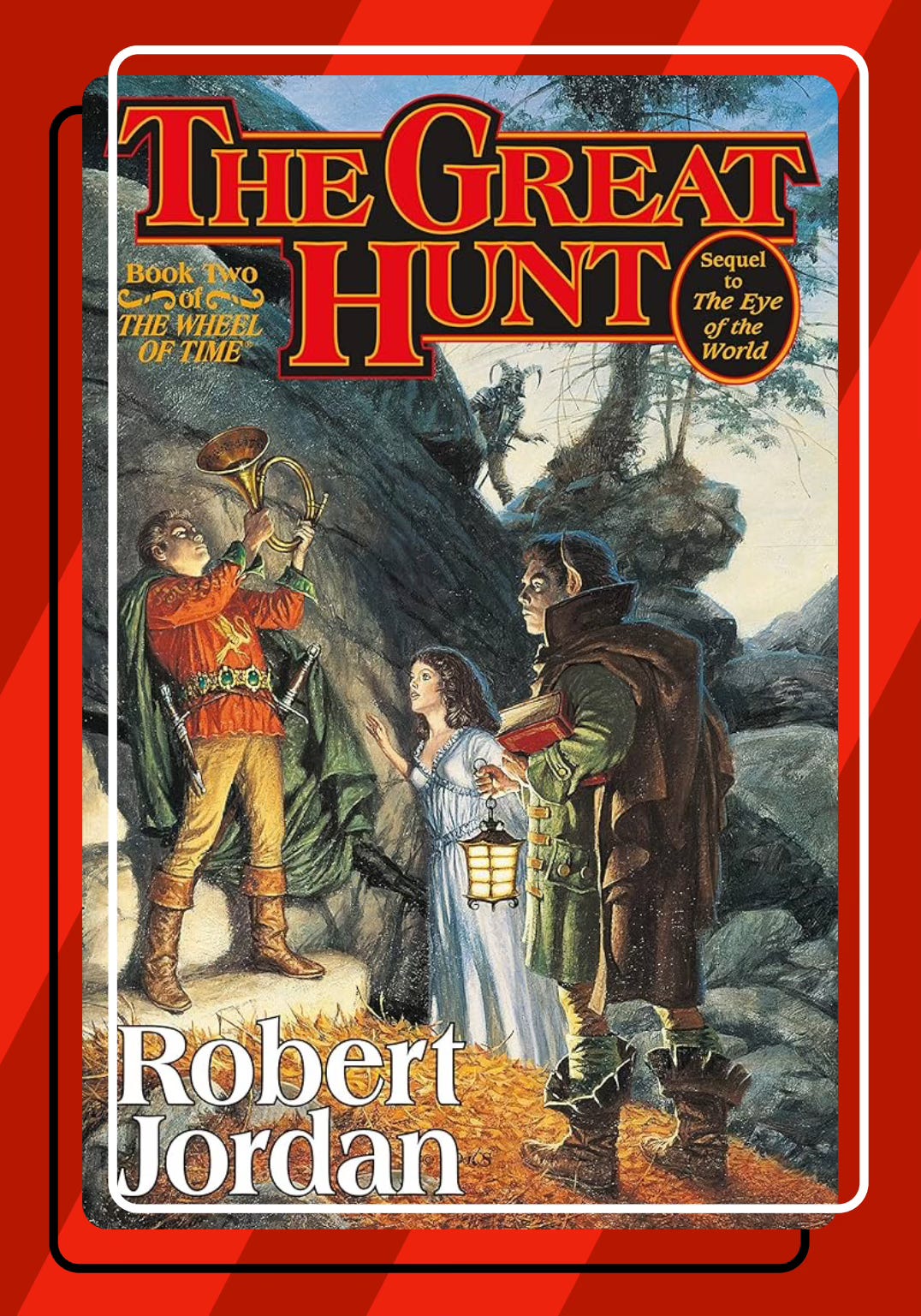
I’m already well into the second book, The Great Hunt. I’ll be writing more about this series as I once again make my way through it. Jordan’s fantasy world owes as much to Dune as it does Tolkien, with incredibly complex and convoluted world building and political intrigue. I’m specifically reading it through a gender-focused lens this time, which is appropriate for a series where the world’s magic power is explicitly split into male and female halves, with the male half tainted by evil and women wielding immense magical (and political) power.
Jordan has taken some hits for his supposed gender essentialism and I recall some spanking stuff around halfway through that doesn’t help his case. But I don’t remember it being quite so cut and dried — he works through many, many permutations of how such a world might grow and falter, some absolutely horrifying. Perhaps my memory is being influenced by Amazon’s Wheel of Time television series that took some interesting swings at the source material and then promptly got cancelled when it got really good.
Jeff Bezos needed to focus his resources on destroying the Washington Post, instead.
I’ll be revisiting the books here in batches as a longer term project for 2026 (and likely 2027). It will take a while because I have another reading project that I’ll be announcing here on Memorial Day that means I’ll need to suppress my urge to re-read giant-ass novels for the next few months. So many books, so little time.
And stay tuned for what’s coming. It’s gonna be a lot of fun.
Finding My Way Back to Paper
Two years ago I wrote a review here of my then-latest technology acquisition: the Kindle Scribe, a combination e-ink tablet for note taking and writing, as well as an oversized e-book reader. A few months later, I wrote a follow-up, noting how deeply the Scribe had become integrated into my daily work and personal life:
“One last thing that I’ve found myself using far more than expected is notations in Kindle books. … I’ve always taken my notes on paper (or sometimes a laptop) as I read, which creates a disconnect between the text and my thoughts. The Scribe solution is a pop-up box for notes, which is tied to a specific location in the text rather than a location on a page. This works super well for me, especially because I can access them easily through my Kindle app on my laptop for when I’m ready to convert those notes into my own writing projects.”
All these months later, the Scribe is still a major part of my daily life. Sheets of yellow paper and Post-It notes remain banished from my desktop. I take it everywhere, so I’m always ready to take notes on a meeting, scribble down otherwise fleeting ideas, or dip into one of the many (many) ebooks I’ve collected over the years.
Well, scratch that last one. I’ve reverted to old-fashioned books on paper in a major way and in large part because of my Scribe.
I have not adopted some anti-ebook attitude. I think ebooks are great and I still grab a few here and there — since my Scribe is always with me that means I always have something to read that’s not my damn phone.
What actually happened was I started taking too many notes.
Jotting notes inside the text seemed super useful at first, especially for books I planned to write about here at the Back Half. But I quickly started hitting some road blocks, primarily that space was limited to fairly short notes. And as time went on, I found the Kindle app on my laptop to be less and less capable of managing my notes, as well as my highlighted passages, which made using it frustrating rather than illuminating when trying to reference them.
I realized I was having a much easier time when reading physical books, despite my initial concerns about a “disconnect” between my thoughts and the page. Taking my notes on the Scribe, where I could scribble out a few hundred words of thoughts and questions with no problem then export them to my Mac, began to free me up. Given my near-genetic-level aversion to writing in books, this was still a big deal for me and my process.
I want to be clear here: I’m not some collectible-focused dilettante who obsesses over maintaining every book I own in mint condition. Books are made to be read and the act of reading is going to inflict some wear and occasionally tear on them. Still, I am a stickler that they should be handled as gently as possible. Every time I see a person reading a paperback with the front cover bent all the way around to the back a piece of my heart dies. If I see you marking your place in a book by folding down the corner you can be certain I am judging you. Use a business card like a caring person does.
You can imagine how I feel when I see some rando posting on #booktok with a video of their pages underlined and highlighted into full-spread rainbows, plus scribbles in the margins, plus Post-It arrows. It sends shivers up my spine. How does anyone make any sense of performative annotations, anyway?
Now here I am, full circle, yet again expanding my already bursting personal library with new hardbacks and trade paperbacks (pour one out for my beloved and defunct mass-market paperbacks). Though I am making far more use of my local library to keep my expenditures somewhat reasonable, I’m not completely crazed.
Luckily, there are no sides to be chosen here. Reading is reading and while there are aspects of physical books I’ll always love — the smell of an older book, the weight of it on your chest when you start to nap — it doesn’t mean I hate the alternatives. There was a dust-up last week on Threads, our most perplexing social media app, over whether or not listening to audiobooks counts as reading that made me understand why I don’t check Threads that often.
Go read a book, however you prefer, wherever you prefer. You can even write in it if you want. Just don’t tell me.

I recently started rereading a series I’d started around 2004 and never finished. Of course that meant I had to start at the very beginning! I finished it and then realized he’d added three more books to the series that I didn’t realize AND did a different short series starring one of the main minor characters from the first one. Of course I had to buy all seven books immediately.
After moving to Mexico, all but two of my books are on kindle now. I never use the highlight thing. And I hate the inability to remove all the bookmarks easily and “start over.” My devices are always trying to synch to different spots depending on what bookmarks they currently have. That business card was much easier.