

The first time I saw someone die was on a tennis court.
My parents used to drive my sister and me around Kentucky in our big yellow van to play small tennis tournaments during the summer. Dad would sometimes play as well, if there was a division for his age. This particular tournament I was playing doubles with a new kid I didn’t know well, Kevin. Our fathers ended up playing each other.
After the dad match got underway, Kevin and his mom left to get some food. I watched them play while sitting with my mom outside the fence. A few games into the set, my dad served — as the ball crossed the net, Kevin’s dad fell backwards onto the hard court.
Dad told me later that he first thought it was a joke, that Kevin’s dad was fooling around about an ace. But he didn’t move after he hit the asphalt. Everything froze for a moment, that split-second it takes everyone to register that something has gone very, very wrong.
“Go, you know CPR,” my mom said. I ran for the entrance at the far end of the courts but by the time I got there another player had already jumped into action, thumping his chest and starting compressions. I stood by the chainlink gate wondering what I should do.
That’s when Kevin and his mom pulled into the parking lot.
I don’t remember who told me to — or even if anyone told me to — but I intercepted them at the gate and tried to keep them from getting too close as others were doing CPR. There I was, a 16-year-old kid, my arm around this woman who was the age of my own mother, trying to calm her as she cried and worried. Kevin paced around us, frightened and angry. I had no words for him beyond, “It’ll be okay,” the only thing I could conceive of saying in the moment.
Someone got to the park payphone pretty quick because the ambulance showed up shortly after. I saw Kevin’s dad being loaded into the ambulance, his face chalky, gray, dead. Once the ambulance had left, carrying Kevin and his mom as well, everyone shuffled around in shock for a bit. Someone mentioned that he had been complaining of heartburn earlier that morning. Everyone agreed that the man was probably dead from a massive heart attack before he even hit the ground.
I never saw Kevin or his mother again.
Joan Didion saw her husband die at their dinner table.
Didion and her husband, John Dunne, were both famous writers, known for their novels, non-fiction, and screenplays, both as individuals and a couple. They bounced between the literary world of New York City and the Hollywood glitz of L.A. On December 30, 2003, they arrived home to their New York apartment after spending an emotionally draining day at the hospital bedside of their daughter, who had been in a coma since Christmas Eve.
After building a fire, pouring a Scotch, and mixing a salad, the two sat down to eat, talking about the World War I book that Dunne was reading.
I have no idea which subject we were on, the Scotch or World War One, at the instant he stopped talking.
I only remember looking up. His left hand was raised and he was slumped motionless. At first I thought he was making a failed joke, an attempt to make the difficulty of the day seem manageable.
I remember saying Don’t do that.
When he did not respond my first thought was that he had started to eat and choked. I remember trying to lift him far enough from the back of the chair to give him the Heimlich. I remember the sense of his weight as he fell forward, first against the table, then to the floor.
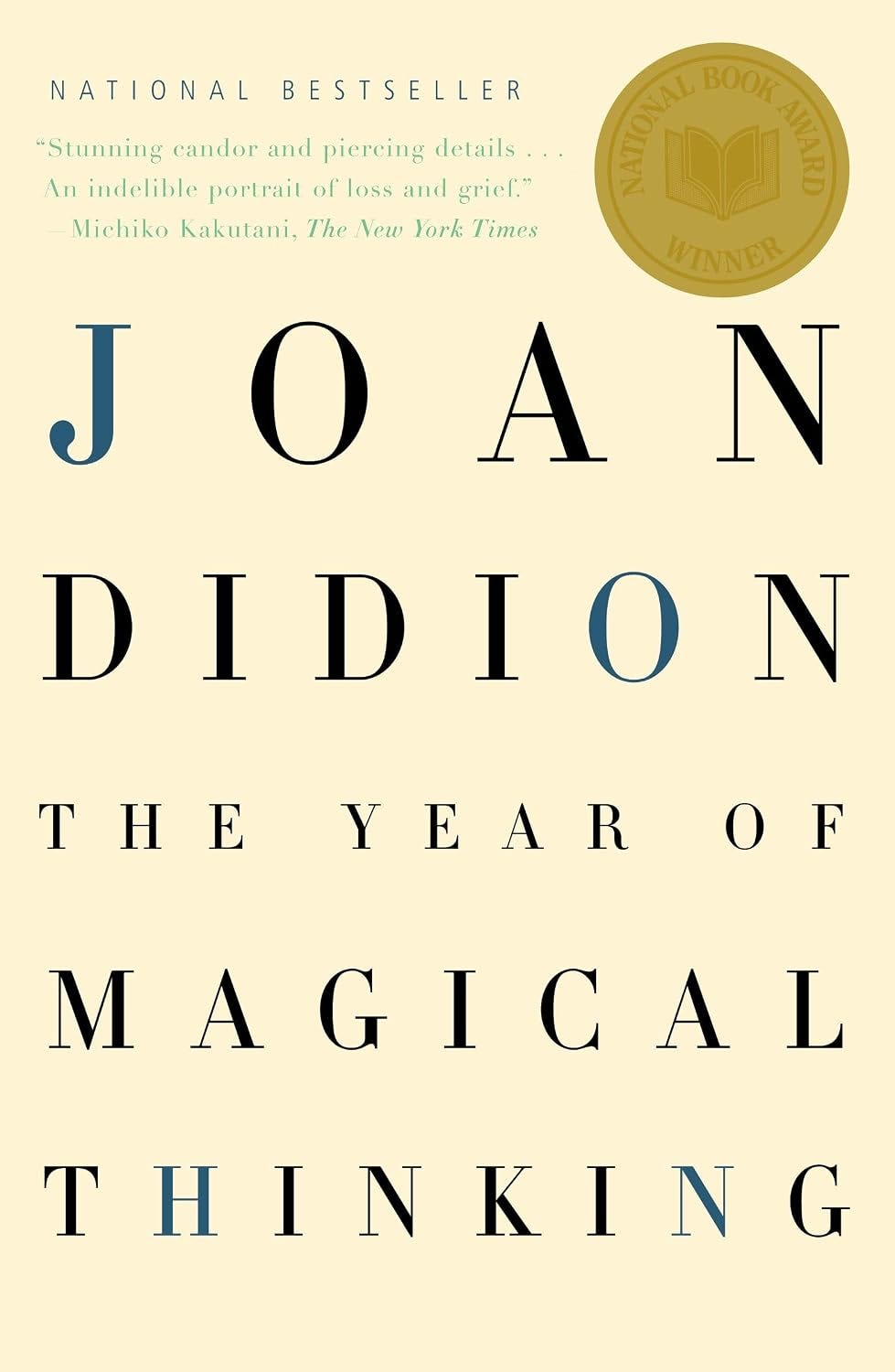
The Year of Magical Thinking is Didion’s memoir of her journey through grief and into mourning, of her forty-year marriage, of her inability to fully accept the reality that her husband would never return.
Grief was passive. Grief happened. Mourning, the act of dealing with grief, required attention.
There’s a reason Didion won the National Book Award with this work. It’s at times beautiful and more often heartbreaking as she struggles to deal with her own mind. She resisted getting rid of Dunne’s belongings, even his shoes.
I stood there for a moment, then realized why: he would need shoes if he was to return.
The recognition of this thought by no means eradicated the thought.
At the very start of book, Didion hones in on an aspect of herself and her writing that is essentially a challenge for her to, if not overcome, then come to peace with her loss.
As a writer, even as a child, long before what I wrote began to be published, I developed a sense that meaning itself was resident in the rhythms of words and sentences and paragraphs, a technique for withholding whatever it was I thought or believed behind an increasingly impenetrable polish.
I read this book a few weeks ago, near the start of Books & Bakes but I kept putting off writing about it because it brought up so many disparate thoughts and feelings and memories of my own. I kept circling back to that Saturday morning on a tennis court in Crittenden County.
Not because of my experience, though those few minutes have stuck with me vividly over the decades, but because of Kevin’s mom. Reading Didion’s account of losing her husband so suddenly to a massive heart attack in what she considered to be a safe and comforting place — their shared and deeply loved home — sent me back to when I was trying to console a wife and mother whose life was being torn open in front of her and her son. Forcing myself to look at my own memory through her eyes fills me with a deep sadness, a wish that I had been able to do or say more, a guilt that after decades I can remember watching a man die but not remember his name.
Back in 2021, I got an urgent call that my mother-in-law “won’t wake up.” I raced over to her husband’s place, around the corner from ours, only to arrive as the paramedics were loading her into the ambulance. I saw her face and I recognized it from that time on the tennis court — chalky, gray, dead. One of my cousins repeated some encouraging words from a paramedic but I knew those were just words to calm and soothe.
She was gone.
I grabbed The Year of Magical Thinking because I had never read Didion, which was a glaring gap in my literary experience. I figured it would be on the depressing side — it’s a memoir about death and outside of culty religious texts those aren’t usually celebratory — but I didn’t expect to be thrown so heavily into my own experiences, direct or indirect, with death.
Hurray for literature!
Making a joke as a coping mechanism aside, I certainly would recommend Didion’s memoir even if it did send me into a bit of spiral. It is beautifully written and painfully honest. I would suggest you wait until you’re in the right frame of mind but that’s the thing about death — it never waits for the best time.