

My personal theory of reading is that books should take you outside your zone of comfort and experience. That means not becoming ensconced in one author, one series, one genre; or, in the case of non-fiction, not relentlessly focusing on one era, one war, or one business-related subject. I certainly dive into rabbit holes, spending a few months at a time, say, getting really into a new sci-fi author I found or obsessively reading multiple books about certain aspects of American history.
I’m generally perplexed by readers who devote themselves to one genre only. For me, I need breaks from the strict tropes required by a narrow genre, even one I enjoy, such as hard sci-fi. I get that not everyone feels the same and it’s far better to be a reader of one genre than not to be a reader at all. But there’s a lot to be gained through proactively stretching beyond those comfort zones.
Luckily, my house is littered with to-be-read piles of books I’m always planning to get to in the ever-distant near future, thanks to my long habit of indiscriminate purchases every time I enter a bookstore. That’s given me a diverse range of books to choose from for the Books & Bakes read-a-thon.
We’re a bit past the halfway point of Books & Bakes, with just under four weeks left. During the first half, I’ve experienced a hard-boiled noir, an occult thriller, two memoirs, two horror novels, a comic thriller, a sci-fi comedy, and a book of political philosophy.
Not bad for an overheated July.
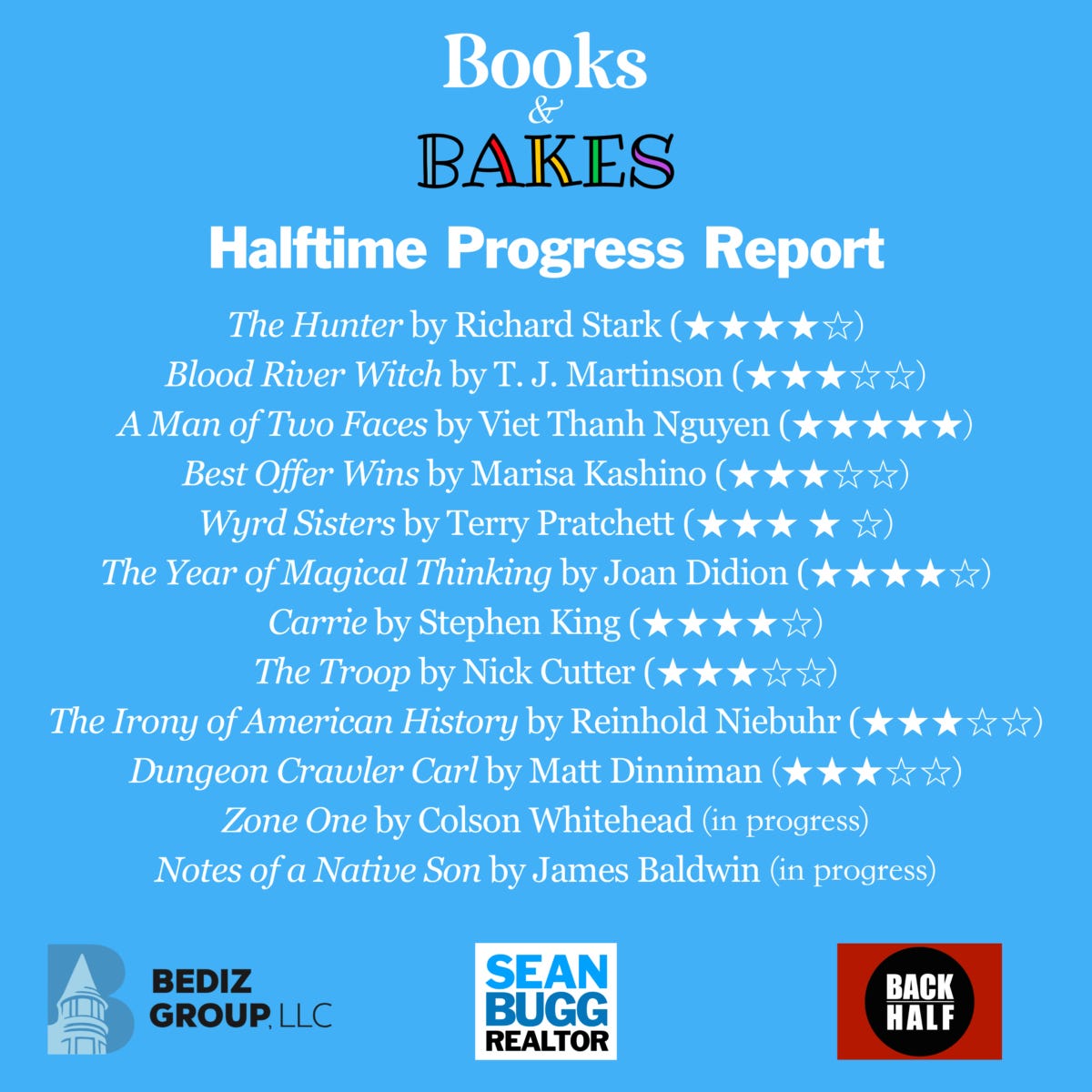
Because I’m still spending a lot of time reading to meet my twenty-book goal, I thought I would do a quick halftime roundup on some of the recent books I’ve read. As you can see in the graphic, I’ve finished ten and have two more in progress (actually three, I started another one last night).
One thing I do want to note is my ranking system. When I rate a book three out of five stars, I mean that’s a good book and worth checking out if it sounds interesting to you. Four of five is a banger that has a little extra juice, in style or story or both. And a five-star book is a jaw-dropping work of craft that I believe everyone should experience.
I don’t have any one or two star ratings — life is too short to spend time reading books you don’t like and there is no shame in not finishing a book that doesn’t work for you.
American Myths and Legends
The Irony of American History has been hanging out in my collection since the Obama administration, one of my stretch goals for reading as Reinhold Niebuhr’s famous work of political philosophy seems fairly influential in center and center-right circles. Our current moment in American history seemed like a good time to finally take the plunge.
The “irony” Niebuhr identifies in American history is one of national self-conception, rooted in a once-rural nation focused on individual liberty but suddenly cast into the role of superpower by World War II and the Cold War. He says:
“Our age is involved in irony because so many dreams of our nation have been so cruelly refuted by history. Our dreams of a pure virtue are dissolved in a situation in which it is possible to exercise the virtue of responsibility toward a community of nations only by counting the prospective guilt of the atomic bomb.”
Niebuhr is not completely wrong about America’s self-narrative (I can feel the political scientists out there rolling their eyes and muttering, “No shit”). But his take on the conflict between America’s virtuous self image and the hard realities of anti-communist realpolitik is deeply rooted in his religious faith, which is something that will lose me every time. And some of his observations from 1952 are flatly hilarious when living in today’s America:
“No powerful nation in history has ever been more reluctant to acknowledge the position it has achieved in the world than we.”
Or,
“Though a tremendous amount of illusion about human nature expresses itself in American culture, our political institutions contain many of the safeguards against the selfish abuse of power which our Calvinist forefathers insisted upon.”
So much for Calvinist insistence.
But what I noticed early on in Niebuhr’s book and that got me more and more riled with every page is his absolute commitment to never mentioning slavery in all his examinations of America as a bastion of virtue. I will never understand how any serious historian or philosopher of America can write pages upon pages about Thomas Jefferson’s agrarian ideal of American as a place of liberty, free of European tyranny and with a superior common class, without mentioning even as an aside that the man owned slaves and that his ideal was built on the institution of slavery.
Niebuhr quotes Abraham Lincoln on the “solemn joy” of sacrificing for freedom but doesn’t grapple with how that freedom wasn’t delivered on in Niebuhr’s own era of Jim Crow and lynchings. He quotes Andrew Johnson — the president who really fucked over America’s chance at becoming a freer nation for all after the Civil War — in support of America’s “Messianic Dream” but doesn’t once engage with the fact that the vast wealth of resources that fueled America’s “virtuous” rise were gained through the conquest and genocide of indigenous people.
I could go on about this for a long time but my main takeaway from this book is that the 1619 Project, so hated by conservatives for trying to center the story of slavery in America’s complex history, has morality and history on its side. The idea that one can write an entire book on America’s “innocency” as a new nation founded on individual liberties without engaging in one of the nation’s two original sins (the treatment of Native Americans being the other) is frankly enraging. It is a moral failing in a book that proposes a highly religious morality in its conception of our nation and its future.
This isn’t an argument that one should not read lauded works of the past or that every idea from the white establishment during the twentieth century should be ignored. It is an argument that we should read American history with our eyes open and with the understanding of why and how white America spent decades omitting the uncomfortable and despicable from the narrative.
Given how worked up I was upon finishing Niebuhr, I grabbed the copy of James Baldwin’s Notes of a Native Son, which I had originally planned to read after the read-a-thon but now seems a necessary addition. I’m not finished yet but a few lines from the eminently quotable Baldwin spoke to me, especially because he was writing in the same era as Niebuhr.
“In the context of the Negro problem neither whites nor blacks, for excellent reasons of their own, have the faintest desire to look back; but I think that the past is all that makes the present coherent, and further, that the past will remain horrible for exactly as long as we refuse to assess it honestly.”
And, of course, this famous one:
“I love America more than any other country in the world, and, for exactly this reason, I insist on the right to criticize her perpetually.”
We could all use a little more Baldwin in our lives these days. I’m looking forward to finishing this one and filling some more gaps in my reading (it’s criminal I haven’t read a queer legend such as Baldwin earlier).
Don’t forget, Books & Bakes runs through Labor Day. There is still time to make your pledge and support the great work of Cake4Kids, bringing birthday cakes and smiles to underserved children.