

Books & Bakes is my read-a-thon raising money for Cake4Kids, an organization that provides birthday cakes to underserved and at-risk children. Every week through Labor Day, I’ll be posting reviews and round-ups of what I’ve read and a preview of what I’m reading. Make your pledge here!
My first memory of Carrie was spotting the movie-tie-in paperback at Readmore bookstore in the Paducah Mall. I would have been eight at the time and I was terrified of it: Sissy Spacek drenched in blood and her eyes bulging and my uneasy thought, How could anyone read something like that?
Two years later, I was reading Stephen King’s The Shining and turning into a lifelong horror fan.
Tastes change quick when you’re young.
But as much of a King fan as I became, I didn’t really get into the book Carrie — his first novel, famously rescued from the trash can by his wife in one of the great sliding-doors moments of American literature. Despite the success of the book, it was Brian de Palma’s film adaption that had my affection. It’s pure horror as catharsis for young tweens and teens who can’t help but put themselves in Carrie White’s bullied and bloodied shoes.
It’s funny, in a way, that de Palma’s Carrie is also one of the most faithful adaptations of a King work ever made. Yet fans of the book have always complained about one particular aspect they see as unfaithful: That despite the iconic performance by Spacek, she’s not fat and she’s not ugly as she supposedly is in the book.
I started thinking about this when the teaser for Mike Flanagan’s new adaptation of Carrie dropped and immediately started online arguments about the new version of Carrie: Why is she not fat?! Why is she not ugly?!
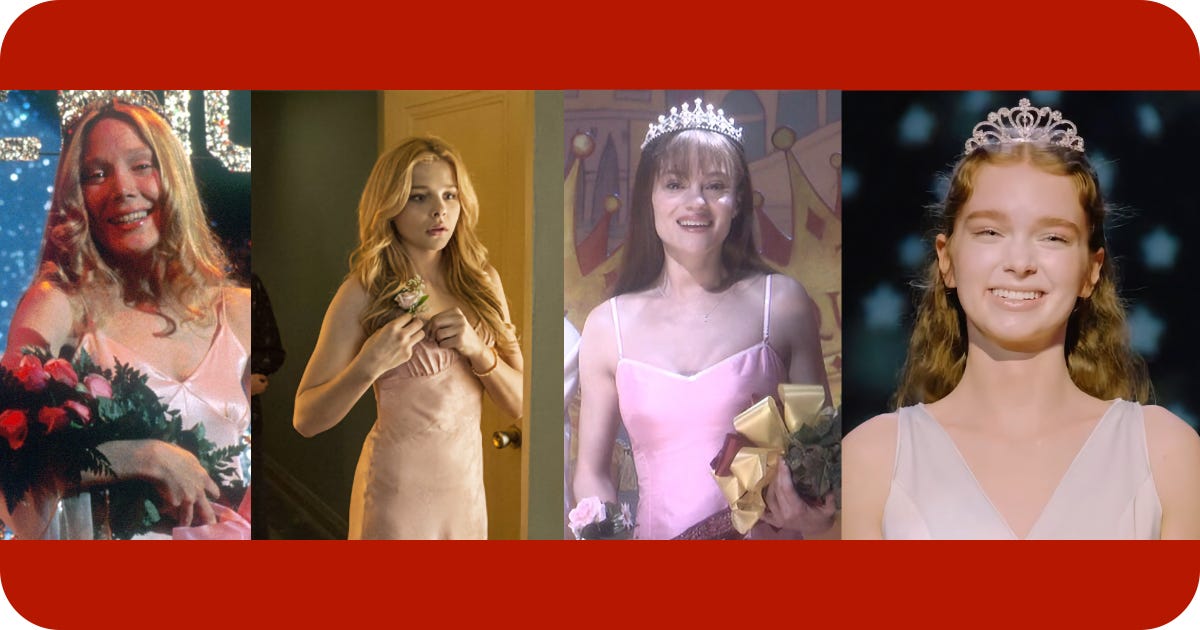
Flanagan is one of the best, if not the best, adaptor of King’s work. He’s done a few, notably his highest-possible difficulty work on Doctor Sleep, King’s own sequel to The Shining. Flanagan managed to adapt that into a film that incorporated both Stanley Kubrick’s Shining (famously hated by King) and King’s novel in a cohesive, coherent movie that respects the artistic achievements of both creators.
So, I was pretty psyched when I heard Flanagan was doing a take on Carrie. I haven’t cared for the other two remakes — a TV miniseries that descended into laughable early-era CGI and the rather boring big-budget version with Julianne Moore and Chloë Grace Moretz — and I actively loathed the abysmal sequel to the original film, Carrie 2: The Rage. With Flanagan promising a miniseries that recontextualizes the novel’s teenage horror story for the age of social media, I believe this could be an interesting take on what it means to be in the panopticon of high school these days.
But those claims that the new Carrie, Summer H. Howell, a slight young woman who isn’t unattractive in the least but isn’t in the mold of Hollywood bombshells, should be fat and ugly to match the book stick in my craw just a bit.
I agree with the criticism that Hollywood films and series have spent decades enforcing unrealistic beauty and body standards for women. And I’ve been glad to see at least some change on those fronts in recent years, even if the old standards still hold the most sway.
But I’m not sure I’m sympathetic to those criticisms when it comes to King, who has a long history of using fatness to signal his characters’ degeneracy, sloth, or villainy. On top of that, King has a bad tendency to throw in “fat” minor or background characters whose weight and bodies are described in lurid, shaming detail. I’ve read just about every King novel there is, many of them multiple times, so I’m pretty familiar with this particular authorial tic.
So, given it’s Books & Bakes season, it seemed a good time to re-read the book where it all started and see just how justified the criticisms of the casting for Carrie are.
Unsurprisingly, it’s more complicated than you might think.
The case for casting a “fat” and “ugly” Carrie starts off fast on page four, in the high school locker room (one of the most terrifying places on earth):
She was a chunky girl with pimples on her neck and back and buttocks, her wet hair completely without color. It rested against her face with dispirited sogginess and she simply stood, head slightly bent, letting the water splat against her flesh and roll off.
King also initially paints Carrie as rather bovine in her response to her gym teacher’s command to finish her shower:
Carrie looked up, her eyes slow and dazed from the heat and the steady, pounding roar of the water. “Ohuh?”
It was a strange and froggy sound, grotesquely apt, and the girls giggled again.
And again, during the infamous onset of her period and the pelting of her with pads and tampons:
Slow, helpless groans jerked out of her. Her eyes rolled with wet whiteness, like the eyes of a hog in the slaughtering pen.
This is all really brutal stuff in a story that is near universally known in American culture. Carrie’s first period, her abuse by both her schoolmates and her mother, her dousing in pig’s blood at the prom, and her subsequent revenge have become a modern myth of the teenage experience.
But is Carrie ugly and fat? Is she an unlikable person who exists solely to make us examine our own tendency to bully the weak and the less-than?
In the book, the answer to that depends on who’s telling the story. King’s novel contains a kaleidoscope of perspectives, with multiple POV characters, news story accounts, and official transcripts. In the opening locker room scene, the perspective is locked in as that of all the other high school students, with a running tally of petty cruelties they’ve visited on Carrie over the years. They see her as fat and ugly because she is the class scapegoat. They can’t see her any other way.
Contrast that with one of Carrie’s neighbors recalling her as a young child:
“She was such a pretty girl … I’ve seen some high school pictures of her, and that horrible fuzzy black-and-white photo on the cover of Newsweek. I look at them and all I can think is, Dear God, where did she go? What did that woman do to her? Then I feel sick and sorry. She was so pretty, with pink cheeks and bright brown eyes, and her hair the shade of blonde you know will darken and get mousy. Sweet is the only word that fits. Sweet and bright and innocent.”
That’s before school and social ostracization take hold of her and begin shaping the perception of her, both by her peers and herself. Her own point of view shows how deeply her self-perception is influenced by others.
She was thick through the waist only because sometimes she felt so miserable, empty, bored, that the only way to fill that gaping, whistling hole was to eat and eat and eat — but she was not that thick through the middle. Her body chemistry would not allow her to go beyond a certain point.
That’s King edging toward his future use of weight as a shorthand for morality but in this case, it speaks to the fact that Carrie isn’t “fat” by traditional or modern sensibilities. She’s obviously not thin but her body and presentation are being mediated by high school cruelty, cruelty that Carrie absorbs and directs towards herself:
She hated her face, her dull, stupid, bovine face, the vapid eyes, the red, shiny pimples, the nest of blackheads. She hated her face most of all.
That’s a fairly typical teenage face for someone just going through puberty, described through a lens of misery. Is that ugly? Or is it self-loathing?
I believe over the course of the quite short novel, it becomes apparent that most of Carrie’s supposed ugliness is projected on her by others and herself. Probably the most important point for this is when the popular and ill-fated Tommy approaches Carrie to ask her to the prom, part of his girlfriend Sue’s atonement for what happened in the locker room. It’s worth quoting in full:
She looked up from her books with a startled wince, as if expecting a blow. The day was overcast and the bank of fluorescents embedded in the ceiling was not particularly kind to her pale complexion. But he saw for the first time (because it was the first time he had really looked) that she was far from repulsive. Her face was round rather than oval, and the eyes were so dark that they seemed to cast shadows beneath them, like bruises. Her hair was darkish blonde, slightly wiry, pulled back in a bun that was not becoming to her. The lips were full, almost lush, the teeth naturally white. A baggy sweater concealed her breasts except for token nubs. The skirt was colorful but awful all the same: It fell to a 1958 mid-shin hem in an odd and clumsy A-line. The calves were strong and rounded (the attempt to conceal these with heathery knee-socks was bizarre but unsuccessful) and handsome.
Tommy’s thoughts on Carrie’s supposed ugliness explicitly change because he changes the way he looks at her. And it is reinforced and fully confirmed when he picks her up for their prom date:
Finally, helpless, she said: “Do you like me?”
He said: “You’re beautiful.”
She was.
This isn’t a make-over story where Carrie suddenly becomes beautiful through the power of makeup and new clothes, although her making herself a dress that fits into the fashion expectations of the time can’t be ignored. Even with that, when she arrives at the prom, some of the girls adopt a very passive-aggressive, faux civility that shows again how her ugliness or beauty are intrinsically linked to who is perceiving her and why.
So, when someone posts online that “you know DAMN well Carrie is supposed to be a FAT white girl” or complaining that Carrie should be “ugly” I have to think they either haven’t read the book in a while or they’ve allowed their own POV and preconceptions to shape their perception. Because a truly fat, ugly, and off-putting Carrie is simply not what the book presents.
Again, there is an extremely valid criticism of Hollywood’s relegation of non-slender, non-white, and non-conventionally attractive bodies to sidekicks, jesters, and villains. But I don’t believe some of the early knives coming out for Flanagan’s casting of Carrie are justified based on the text.
I’m a big Flanagan fan, so I’m looking forward to his take on Carrie this October. Will it be good? I hope so. Will it be different from the book? It should be, otherwise what’s the point? It’s fun to see a book you love adapted for a screen and see the things you once imagined in your head writ large and near tangible. But that can change your experience of the book that you love — so many times I’ve gone back to re-read a book that spawned a famous movie only to find the images and characters I’d created with my own mind replaced by actors and effects I had nothing to do with. A less “faithful” adaptation can both entertain and leave my enjoyment of the original text unchanged.
But mostly, I’ll just be glad my high school days are so, so far behind me.