


When I started cracking open all these old SF magazines from my childhood, I hoped to find examples of the predictions I was promised at the time to compare them to today. It’s a fair way to read the past given that science fiction’s strongest foundation is the desire to predict the future via technology and human achievement.
Then there’s the whole quagmire of asking how these writers of the past influenced our tech leaders of the present, particularly those of my generation who ostentatiously tout those influences in the names of their companies, products, and corpo-speak mission statements.
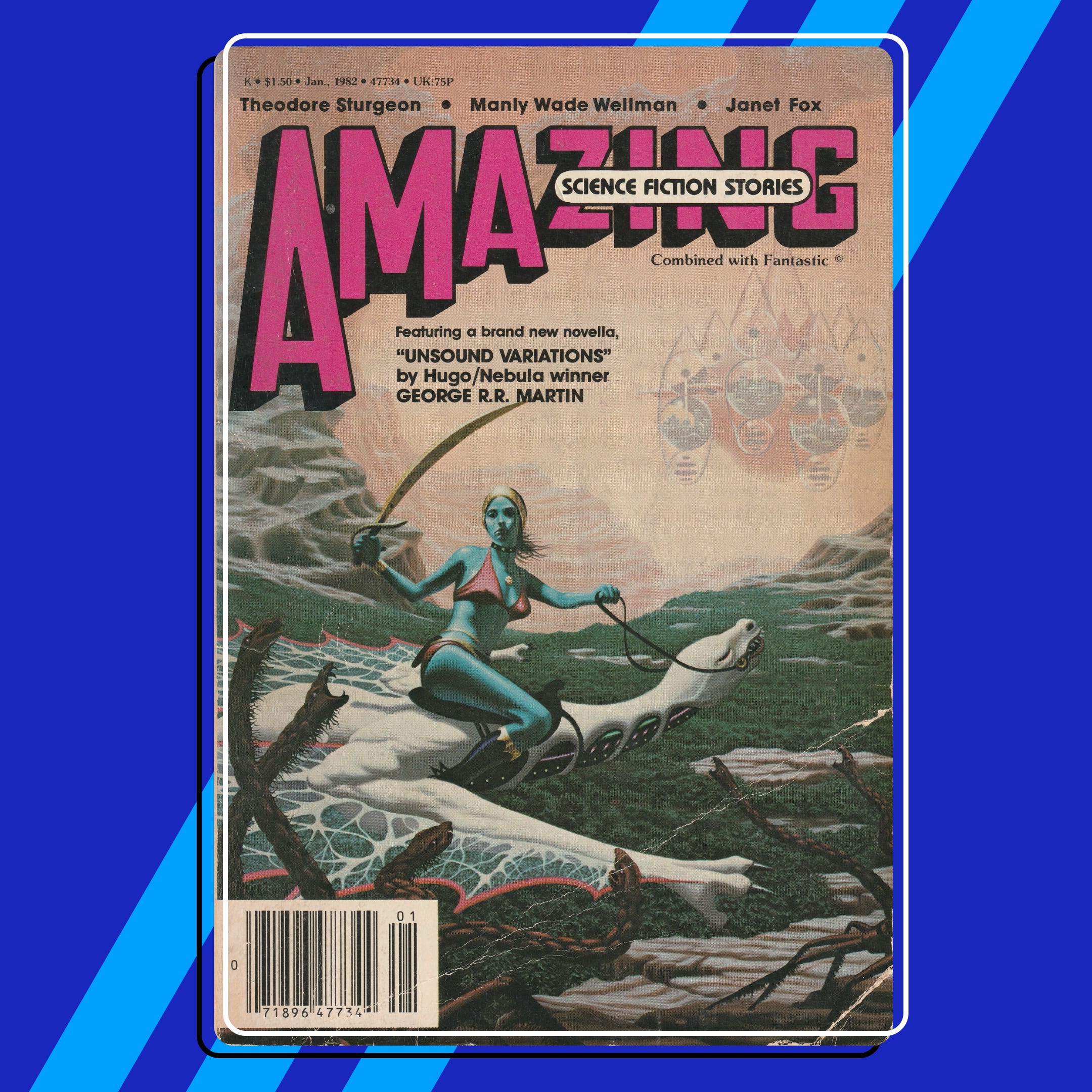
In this January 1982 issue of Amazing Science Fiction Stories I stumbled on a doozy of wishful techno thinking that definitely reaches forward to today: “Futures Fantastic: Toward Human Immortality.”
To cop a phrase from Battlestar Galactica, all of this has happened before and all of this will happen again.
This is basically a round-up of the state of research on aging in the early 1980s by writer J. Ray Dettling, with the goal of promoting funding for more research. Fair enough, enthusiastic support for science and research is one of the more laudable aspects of science fiction as a genre (unless it’s Jerry Pournelle and his ilk advocating for space lasers and targeted nuke strikes). But reading it only gave me deja vu and an immense sense of loss.
First, there’s the proliferation of anti-aging buzzwords that remain with us to this day: antioxidants, free radicals, periodic fasting, and (of course) cryogenics. The idea at the time was that antioxidants and related research would extend human life expectancy — read that as “American” life expectancy — by 20 years by the year 2000.
U.S. life expectancy was 74.5 in 1982. By 2000 it had shot up to…76.9! And today it’s gone up all the way to 79.4.1
“A recent Rand Corporation Study concluded that by the year 2020 (only 40 years hence),” Dettling says, “we will have added 50 years to the human lifespan.”
The lesson here, which I don’t believe we’ve learned, is to stop paying so much attention to Rand Corporation studies. Also, the economic and cultural chaos that would be unleashed by nearly doubling the human lifespan in that short of a period would be, well, a good hook for a science fiction story. Not to mention the realization that we should be both cautious in what we wish for and discerning in our acceptance of long-term predictions.
I’m not being Malthusian there, even though this piece once again raises the Malthusian argument that everyone loved — unchecked economic growth would create population growth that would overwhelm agricultural capacity — that turned out to be bunk because economically secure women don’t feel the need to birth six to a dozen babies apiece. (Yes, I’m oversimplifying, it’s fine.) But if you’re tired of Boomers and Gen Xers now, imagine if you wouldn’t be rid of them until 2085 or so.
Anyway, a five year increase isn’t nothing, depending on the quality of those additional years. But given the hostility to science and expertise currently running the nation, alongside a cult-like worship of quackism led by RFK Jr., we’re not gonna be getting that kind of extension in this century. Personally, I think we’ll be lucky if we manage to stay at 79.4 for the next couple of decades, since even that was a rebound from the depths of Covid when life expectancy dipped back to 76.3.
When you gut public health, destroy the nation’s capacity for research, and stop using the vaccines that played a huge role in the life expectancy leap from 1950 (68.1 years) onward, good things aren’t going to happen.
One last gem: “[A] surgical technique called parabiosis was performed in which aged organisms were connected to young organisms like siamese twins. Thus the blood of the young subject could mix with the blood of the older subject. The aged organisms showed immediate signs of rejuvenation and greatly outlived the animals in the control group.”
So that’s where Peter Thiel got his gay vampire plan from.
The Stories
Full honesty, this is not a good issue for short SF stories. Mostly meh with the new stuff and the “Amazing Hall of Fame” re-print, “A Way of Thinking” by Theodore Sturgeon, is just boring in a way that I didn’t expect from a Sturgeon story.
One that stands out in a bad way is Steven Ray Daugherty’s “Comnet 2 Enters the 21st Century,” a Network riff (or ripoff, take your pick) about a future TV network’s rapacious low-brow programming that whacks you over the head with the unrelenting and ubiquitous homophobia that may ultimately drive me off this project: “Alex slides out of his chair, his knees buckling as they collide with the back of Little Tom, who is kneeling under the desk in order to service his boss. (No kidding, it’s a jungle out there.)” That’s followed up with a bunch of proto-MAGA bullshit about the “Federal Bureau of Minority Opinion” and the “Gay Rights Advisory Commission.”
So, let’s just move on to easily the high point of the issue, George R. R. Martin’s “Unsound Variations,” a story about chess that I expected to hate — I really do not care for chess, a game that is wildly overused as a metaphor and framework — but ended up liking very much.
That’s because Martin is a great writer and the chess theme here works well as a larger theme for aging and life choices. A rich, Elon Musk-type calls his college chess buddies together for a cloistered weekend, revealing he has used a time-travel technique to systematically ruin each of their lives as revenge for humiliating him in an undergrad chess tournament. All of that leads to a meditation on aging and life choices, both those we make and those that are made for us:
“Once the game begins, the possibilities narrow and narrow and narrow, the other variations fade, and you’re left with what you’ve got — a position half of your own making, and half chance, as embodied by that stranger across the board. … The might-have-beens are gone.”
I’m not sure I could describe life post-50 more succinctly than that.
It’s easy for people to hate on Martin these days because of their frustration with his incomplete greatest work. But people need to remember he’s long been a prolific part of the science-fiction and fantasy world and we would be worse off without him. Unlike many of the stories I’ve been writing about in Flashback, this one is pretty easy to pick up — it’s part of his Dreamsongs: Volume II short story collection. Give it a go.
Books & Bakes Read-a-Thon
And that’s a wrap on Amazing January 1982. I do have some other things in the pipeline that should be fun but don’t forget about “Books & Bakes,” my summer read-a-thon benefiting Cake4Kids. I’m a volunteer baker for Cake4Kids, which provides birthday cakes to at-risk and underserved kids in our community. It’s a wonderful organization and I’m excited to have this new way to share and support its mission.

There will definitely be some sci-fi and fantasy included over the course of July and August, so you won’t want to miss out. Next week I’ll be posting some previews of the books I’ll be reading (and writing about) on The Back Half.
To learn more about “Books & Bakes” and Cake4Kids, as well as make a pledge, check out my other website: seanbuggrealtor.com/books-and-bakes. Let’s have a great summer reading!

All life expectancy data I reference can be found here: https://www.macrotrends.net/global-metrics/countries/usa/united-states/life-expectancy