

I knew from the start that going back and re-reading the science fiction and horror novels that shaped me as a young reader would put me face-to-face with some ugly homophobia.
I just didn’t realize how much there would be.
My eyes aren’t clouded. I remember well the casual homophobia that permeated all media during the Seventies and Eighties. I knew early on what a faggot was and that I was one. Every time I ran into that word in a book or movie, it hurt a little because I secretly knew it meant me. But that part of me quickly grew calloused, which allowed me to maintain my voracious consumption of genre novels and short stories.
Going back and re-reading now I feel sorry for my younger self — and other young queer readers of the time — because the homophobia was so endemic to nearly everything. This isn’t just about genre, homophobia (and its partners in bigotry, racism and misogyny) were everywhere, even books and movies that purported to be sympathetic to homosexuality.
Perhaps sometime I’ll go on my rant about how much I loathe The Boys the in the Band.
All to say that when I decided to dip back into the world of 2001: A Space Odyssey — the film and the book — I wasn’t expecting to be smacked in the face with the anti-gay tropes of the time. Stanley Kubrick’s film has grander ambitions than interpersonal human relationships. Arthur C. Clarke was a fairly progressive humanist and quasi-closeted gay man living with his partner in Sri Lanka. There wouldn’t seem to be a lot of space for inserting random homophobia into either film or book.
One would think.
I no longer have the original version of Clarke’s novel from 1968 (so many books lost to moves and time) so I picked up the “Millennial Edition” from 1999, which includes a foreword recounting his collaboration with Kubrick. It was a unique process, with the two of them crafting the screenplay and Clarke drafting the novel, he says, “with feedback in both directions.” It’s fascinating to learn how Clarke actually rewrote sections after viewing early scenes from the movie.
He includes some moments from his journal, which is where I hit on this nugget from Oct. 17, 1964:
“Stanley has invented the wild idea of slightly fag robots who create a Victorian environment to put our heroes at ease.”
Goddammit.
Clarke — again, a gay man — included this in his 1999-written foreword so you can see that standards have still only recently and imperfectly changed for this kind of stuff. Though it is darkly amusing that Kubrick almost created C-3P0 and R2-D2 a decade before George Lucas got around to it. This moment also puts one of the ending scenes of the movie — Dave Bowman living out a lifetime in a old-world European hotel room — into a new context.
Does this change the status of these two works of art or my opinion of them? No. It’s just a reminder that homophobia in all these works that I love is like a pebble in my shoe that I’ll never get out, nagging and inescapable.
Mercifully, that pebble doesn’t show up in the actual film or novel, which are both keenly focused on human evolution, consciousness, and technology. That’s not to say that they’re devoid of social context — the relegation of women to the furthest of sidelines may be a product of the time but it is so extreme that it begins to feel like a deliberate choice.
Clarke includes this howler in the novel regarding the use of female names for the extravehicular pods onboard the spaceship Discovery: “They were usually christened with feminine names, perhaps in recognition of the fact that their personalities were sometimes slightly unpredictable.”
No wonder so many women felt there was no place for them in science fiction and fantasy.
To step back and look at both separately, it’s hard not to argue that Kubrick’s film version is the superior work of art, by lightyears. It is audacious in ways Clarke’s can’t even begin to emulate. One of the most visually striking films in movie history actually opens on three minutes of a black screen and haunting orchestral score, that feels like a dare or a warning. Then there’s Kubrick’s devotion to showing the story rather than telling it, especially in the opening section where the monolith bestows the use of tools on our ancestors (and who promptly get to killing).
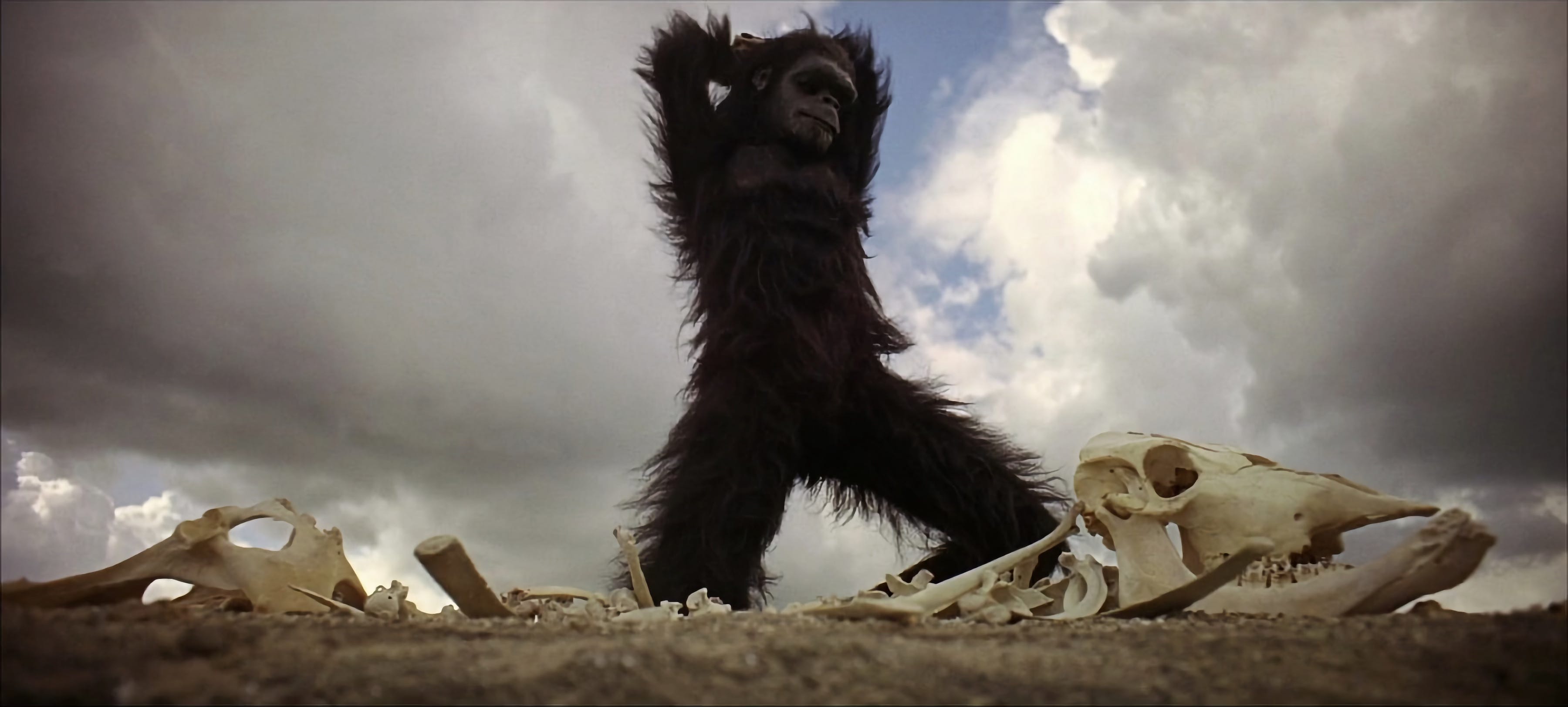
Kubrick’s 2001 has been analyzed to death so I’m not jumping into takes that have been done ad nauseum for decades. What actually struck me the most was how fast this supposedly ponderous movie feels. Perhaps I’ve grown more patient with age but my memories of the movie — especially the Dawn of Man — were that they were interesting but interminable. Those were false memories. Kubrick is certainly deliberate but everything on screen is communicating something, whether it’s the origins of man’s technology or the intricacies of interplanetary physics. Plus, he goes full on horror movie in the middle: the doomed astronaut’s final spacewalk is terrifying both from the vastness of space and the stalking space pod that the computer Hal commandeers.
Also, it’s quaint that a two-and-a-half hour film has an intermission embedded in the middle, a bladder-friendly accommodation we can’t get these days even during three-hour blockbusters.
The funny thing about 2001, a movie that has launched thousands of interpretations and analyses, is that if you’re confused you don’t have to be. Clarke spells it all out in the book.
Truly, Clarke’s novel is a 1968 version of a YouTube explainer video, answering every who, what, when, where, why and how you may have. Do you have questions about how the monolith changed the early humans, or what they experienced when the monolith touched them? Clark spells it out with the entranced apes:
“They could never guess that their minds were being probed, their bodies mapped, their reactions studied, their potentials evaluated. … Then the man-ape nearest to the slab suddenly came to life. … his body lost its trancelike rigidity and became animated as if it were a puppet controlled by invisible strings. The head turned this way and that; the mouth silently opened and closed; the hands clenched and unclenched. Then he bent down, snapped off a long stalk of grass, and attempted to tie it into a knot with clumsy fingers.”
Or, near the end of the film, when Bowman encounters the giant monolith in space and begins his final kaleidoscopic journey that inspired both acid trips and questions of What does it all mean? Well, here’s what it means:
“Call it the Star Gate.
“For three million years, it had circled Saturn, waiting for a moment of destiny that might never come. In its making, a moon had been shattered, and the debris of its creation orbited still.
“Now the long wait is ending. On yet another world, intelligence had been born and was escaping from its planetary cradle. An ancient experiment was about to reach its climax.
“Those who had begun that experiment, so long ago, had not been men — or even remotely human. But they were flesh and blood, and when they looked out across the deeps of space, they had felt awe, and wonder, and loneliness. As soon as they possessed the power, they set forth for the stars.”
It would be easy to dismiss this literalism as a bit of a joke when comparing it to Kubrick’s vision, which hints and alludes to these ideas. Despite all the stories of people leaving the theater perplexed about what they had just seen, 2001 the movie isn’t actually all that complicated. Perhaps it’s because I’ve seen it multiple times and I am deeply familiar with the core ideas that fuel so much science fiction that it feels very obvious to me.
Still, Kubrick took their shared screenplay and created a meditation on humanity’s place and potential in the cosmos, leaving much unsaid and open to interpretation.
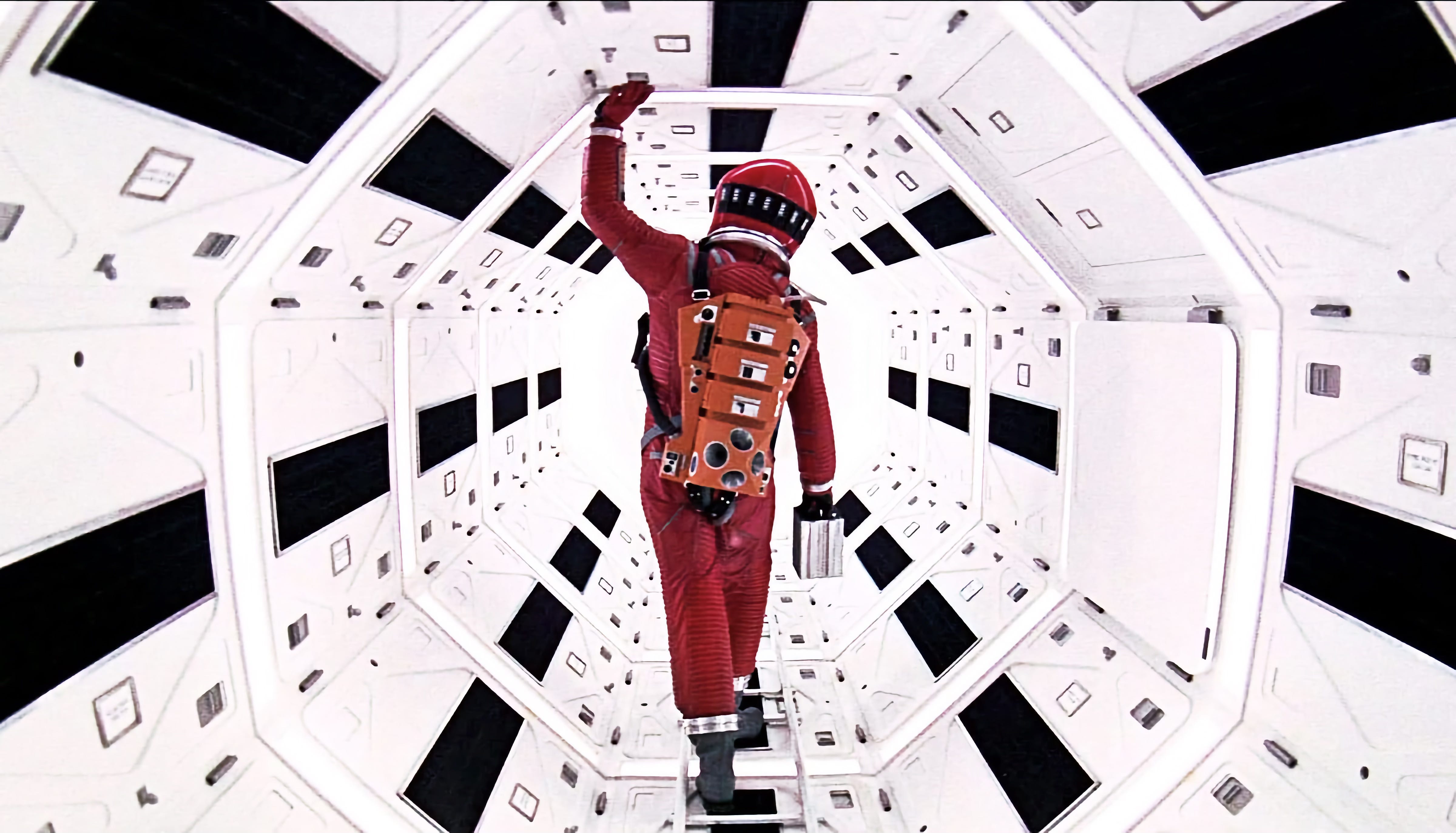
Clarke, on the other hand, had no interest in leaving things unsaid. Clarke was a proselytizer for science and human advancement — he saw the pursuit of space travel as a glorious goal for our species that would drive us outward into wonder as well as heal our worst tendencies. He was deeply optimistic about the use of technology to bring about more equal societies and potentially contact other civilizations that transcended their humble biological beginnings to create cultures of consciousness: beings able to not only observe the universe around them but to appreciate its beauty and wonder.
Which brings me to the other point of difference between these two versions of a story born through collaboration. Kubrick’s work is a masterpiece of film, using every tool at his disposal — editing, lighting, cinematography, visual effects — to create an enduring work that not only holds up beyond its dated world of U.S.-Soviet domination and rigid gender roles but makes profound statements on humanity and the nature of consciousness.
Clarke’s novel is, well, notable for the ideas he conveys.
I don’t mean this as an insult to Clarke who, like many of the writers of “classic” science fiction, was a competent writer rather than a literary stylist. This is “big idea” science fiction, where the premium is on the scientific concepts on display. Isaac Asimov definitely wrote in this vein, particularly his Foundation series, and you still see it today among many “hard science fiction” writers who spend pages on the technicalities of spaceship design while tossing perhaps a paragraph or two to character development.
Again, not an insult. I enjoy a lot of that hard SF focused on orbital mechanics, time dilation at near light-speed travel, and all sorts of fun science stuff. But if you’re looking for stirring prose, this is not the type of work where you’ll find it.
Also, to be fair to Clarke, he does generally consider the film and the novel two separate works despite him being the common creator of the two. And the book does differ in some significant ways, primarily making Jupiter — the climactic location of the film — a waypoint on the journey to Saturn, where the book’s climax takes place. Still, as Clarke himself notes in his foreword, “[E]ven in my own mind, book and movie tend to be confused with each other.”
That’s unavoidable given the status of the film. It’s so unavoidable, in fact, that Clarke abandoned his differentiation when he wrote the sequel, 2010: Odyssey Two, moving the action back to Jupiter. And that novel was then made into a movie sequel, 2010: The Year We Make Contact, an overall fascinating series of events in terms of creation and collaboration. I haven’t seen or read those since the Eighties, so I may add those to my list just to compare. Hell, I could probably do an entire series on science fiction works of the time that posited distant futures dominated by U.S.-Soviet tension and/or collaboration.
Nearly everyone back then really did overestimate Russia and underestimate China.
So, when it comes to 2001: A Space Odyssey, are both the movie and the novel worth spending time with nearly sixty years later? When it comes to Kubrick’s film, unequivocally yes. While some stuff around the edges doesn’t hold up — the lack of women most prominently — the rest is astoundingly prescient and we have Clarke to thank for that just as much as Kubrick’s ability to bring the concepts to life with special effects that still look amazing.
For Clarke’s novel, I’d say that’s for completists, especially if you’re interested in following the story through his entire four-book series, continuing through 2061: Odyssey Three and 3001: The Final Odyssey. It’s been a while since I read them but I recall it getting a little wild by the end. Also, despite the early trip-up I had with the mention of fag robots, overall Clarke remains a charming, if often naive, optimist about humans and technology.
Given the techno-dystopia currently being foisted on us by techbros who claim to be inspired by him, it’s worth going back to the source to see what they’re missing.